Shining Charizard: The Original Shiny Chase Card
Before every set had an alt-art secret rare, Neo Destiny gave collectors the Shining Pokémon — and Shining Charizard is the one that still defines the vintage-holo top shelf.
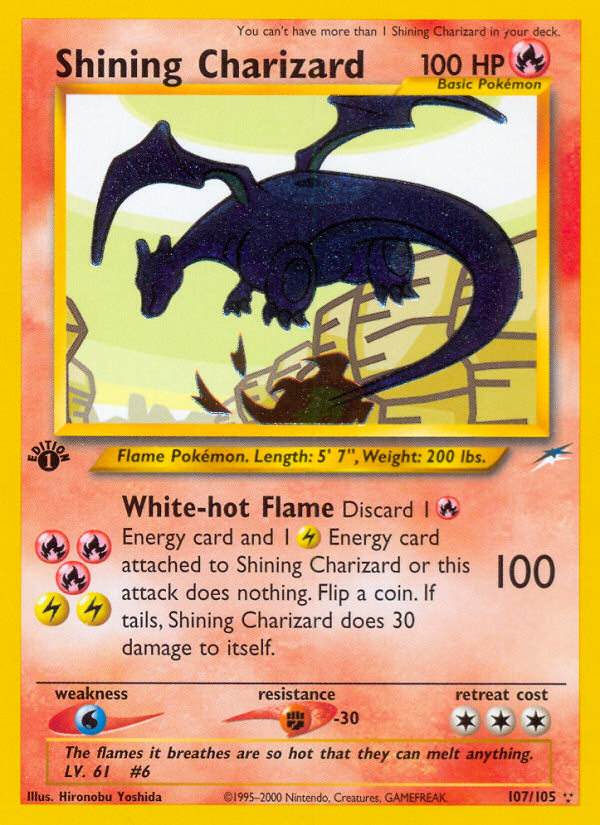
Long before modern sets shipped with alternate-art secret rares in every booster box, the 2002 set Neo Destiny introduced the Shining Pokémon — cards printed with a distinctive alternate coloration and a foil treatment that looked nothing like a standard holo. Shining Charizard, number 107/105, is the crown of that subset and one of the defining chase cards of the entire Wizards-of-the-Coast era.
The Shining cards were the first time the hobby had a 'chase within the chase' — a secret rare that even the holo Charizard collectors did not have.On why the Shining subset mattered
What makes a Shining card different
The Shining Pokémon used an alternate body color — Shining Charizard is famously a gold-and-grey rather than the usual orange — paired with a busy, sparkling foil across the whole card. They sat above the numbered set as secret rares, so pulling one was genuinely uncommon. That combination of an off-model 'shiny' look and true secret-rare scarcity is exactly what made them the era's most talked-about pulls, and it is why the name Shining still carries weight with vintage collectors two decades later.
How the value behaves
Shining Charizard is a vintage card, which means condition is everything and supply is genuinely fixed — no more were ever printed, and every clean copy is more than twenty years old. Raw copies trade across a wide band depending on centering and surface, and the graded ladder climbs steeply: a PSA 9 sits well above a raw card, and a PSA 10 sits far above the 9 because gem-mint vintage holos are legitimately hard to find. The 2002 foil scratches easily and the print runs had real centering variance, so high grades are scarce on their own terms.
That is the key difference from a modern chase card. With Moonbreon-era cards, the population grows slowly but the cards are young and often mint. With Shining Charizard, two decades of handling mean truly clean copies keep getting rarer, not more common — every card that gets played, scratched, or damaged is one fewer gem candidate. For a vintage secret rare, time works in favor of the best-preserved copies.
What to check before you buy
First, confirm you are looking at the genuine Neo Destiny 107/105 and not a proxy or a later reprint of the Shining concept — the era, set symbol, and card number should all line up. Second, inspect the foil under angled light for the fine scratches this surface is prone to. Third, check centering on both faces; WOTC-era print variance is real and it is the most common reason a gorgeous-looking card grades below gem. Fourth, if you are buying a slab, verify the cert against the grader's population lookup.
Frequently asked questions
Why is Shining Charizard gold instead of orange?
The Shining subset used an alternate 'shiny' coloration, the same idea as a shiny Pokémon in the video games. Shining Charizard's alternate palette is part of what made the card instantly recognizable and highly wanted.
Is it the same as the Base Set Charizard?
No. Base Set Charizard (4/102, 1999) is the iconic first-edition-era holo. Shining Charizard (107/105, Neo Destiny, 2002) is a later secret rare with an alternate color and foil. They are different cards from different eras, and both are era-defining chases in their own right.
Does the vintage foil affect grading?
Significantly. The Neo-era Shining foil scratches and shows surface wear easily, and WOTC centering was inconsistent. That is why gem-mint copies are scarce and command a large premium over a PSA 9 — the surface and centering are the two hardest boxes to tick.