A BGS 10 Black Label Mega Charizard Hit $47,600 — While Raw Copies Trade Under $1,000
The Phantasmal Flames #125 SIR is a $47,600 card in a Black Label slab and a sub-$1,000 card raw. Here is what four perfect 10 subgrades actually buy — and why the gap is the whole story.
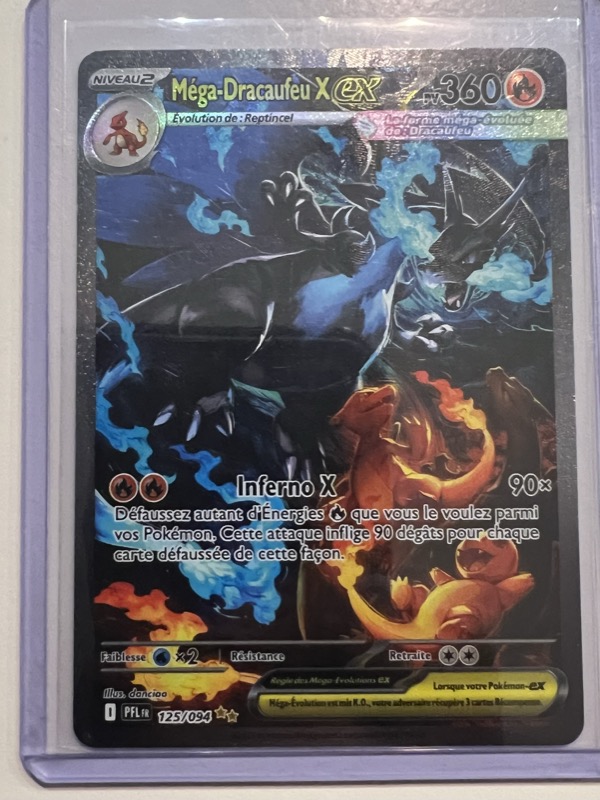
In April 2026, a single card changed hands four times in a matter of weeks: the Mega Charizard X ex Special Illustration Rare — Phantasmal Flames #125 — in a BGS 10 Black Label slab. The prints read $47,600, $45,100, $43,920 at Goldin, and $41,099. The same card, raw and near-mint, is the one in our collection — sold at $999.99. One holder, one grade, and roughly a 45x multiple between them.
A card with four perfect 10 subgrades earns the rare Black Label — and Black Labels can sell for 2 to 5 times the price of a standard BGS 9.5 Gem Mint.The industry rule of thumb for BGS Black — here stretched to nearly 45x raw
What a "Black Label" actually is
Beckett grades a card on four subgrades — Centering, Corners, Edges, and Surface — and a fifth overall number that is not a simple average. A standard BGS 10 Pristine can hide a 9.5 in one of the four categories, so long as the rest carry it to a perfect overall. The Black Label is the version with no hiding place: all four subgrades read a flat 10. Centering at 50/50 front and 60/40 back, corners with no rounding, edges with no chipping, surface with no print line, scratch, or factory haze under angled light.
Two consequences follow. First, the Black Label is a modern-only award — Beckett does not hand it to pre-1980 cardboard — which is exactly why a 2025 Charizard chase card is even eligible. Second, four simultaneous perfect 10s on a foil-heavy Special Illustration Rare is genuinely rare: SIRs land in well under 1% of packs to begin with, and the textured foil that makes them beautiful is precisely what surfaces and edges fail on. The Black Label population on #125 is a sliver of an already-thin graded pool.
The raw-to-slab gap, laid out
Strip the plastic and the same #125 is an ordinary — if gorgeous — modern chase card. Raw near-mint copies trade under a thousand dollars; PriceCharting has ungraded around $800 and PSA 10s near $2,000. Our sold copy printed at $999.99, a clean number for a clean raw card. The Black Label is not a different card. It is the same artwork, the same print run, wrapped in the market's rarest certificate of perfection — and that certificate is doing roughly 98% of the price.
This is the inversion of the vintage story, where scarcity of the object drives value. Here the object is abundant and the grade is scarce. Submit ten mint-looking raw #125s and you might get one Black Label, several Pristine 10s, and a scatter of 9.5s — each tier a different asset class. A JP SAR 110/080 (Inferno X) in the same Black Label holder has been listed as high as $45,000, confirming the pattern crosses languages: the perfect-10 tier is its own market, decoupled from the raw floor beneath it.
Why a Charizard slab commands five figures
Three forces stack. Charizard is the single most bid-on name in the hobby, so any perfect-10 Charizard inherits the deepest buyer pool in Pokémon. Black Label supply is capped by physics — you cannot manufacture more perfect surfaces after the fact — so demand has nowhere to go but price. And Phantasmal Flames is a 2025 set still fresh in supply-shock territory: the highest grades were bought before the population report could catch up, and the auction record became the comp before a floor could form.
The risk cuts the other way too, and honesty demands stating it. Modern populations grow. Every reprint window, every fresh case break, feeds more #125s into graders, and a Black Label that is pop-12 today can be pop-40 in eighteen months. Vintage gems are scarce forever; a 2025 chase card's perfect tier is scarce for now. The $47,600 print is a real, verifiable auction result — but it is a snapshot of a young market, not a vintage floor.
Other Fire-type and Beckett stories worth reading
The raw-versus-slab gap and the grader-label premium show up across the hobby. These related cards in our collection each tell a piece of it — a vintage 1st Edition gem, a cracked-ice holo oddity, and a French classic Fire bird.
Related cards
The verdict
The $47,600 print is honest, but read it for what it is: the market paying for a certificate of perfection, not for a rarer object. Raw, this is a sub-$1,000 chase card and a lovely one — our $999.99 sale is the real floor. If you own a mint-looking #125, the entire question is whether its surface can carry four flat 10s under angled light, because that single label is the difference between a thousand dollars and forty-five. And if you own the Black Label already, the quiet risk is not that Charizard falls out of favor — it is that the population report keeps climbing.
Frequently asked questions
What is a BGS 10 Black Label?
It is a Beckett grade where all four subgrades — Centering, Corners, Edges, and Surface — each read a perfect 10, not just the overall number. A standard BGS 10 Pristine can carry one 9.5 subgrade; the Black Label cannot. It is a modern-only award, which is why a 2025 Charizard is eligible for one.
Why did the Black Label Mega Charizard sell for around $47,600 when raw copies are under $1,000?
Because the price is paying for the grade, not the card. The #125 SIR is an abundant modern chase card raw, but four simultaneous perfect 10 subgrades on a textured foil card are extremely scarce. Deep Charizard demand plus a capped supply of perfect surfaces produces a five-figure result — roughly 45x the raw floor.
Is a modern Black Label a safe long-term hold?
It carries a specific risk vintage gems do not: population growth. A 2025 set is still being opened and graded, so today's tiny Black Label pop can multiply as more cases break. The $47,600 result is a verified auction comp, but it is a snapshot of a young market, not a fixed vintage floor.
How does the Japanese SAR compare to the English #125?
The Japanese SAR 110/080 (Inferno X) in a BGS 10 Black Label has been listed as high as about $45,000, tracking the English #125's five-figure Black Label band closely. Both confirm the same pattern: the perfect-10 tier is its own market, decoupled from the sub-$1,000 raw floor beneath it.