Why Gengar Keeps Winning Auctions — and What the Japanese Neo Destiny Dark Gengar Is Really Worth
Gengar's fandom never fades, and the collectors chasing five-figure Fossil and alt-art trophies quietly pull up everything with his name on it. Here is the honest grading-upside math on the 2001 Japanese Neo Destiny Dark Gengar — raw ~$250, PSA 9 ~$1,040, PSA 10 ~$4,250.
Few Pokémon carry a fanbase like Gengar's. The grinning shadow has been a fan-favourite since Red and Blue, and that devotion shows up on the auction block: 1st Edition Fossil Gengar holos in PSA 10 have printed anywhere from roughly $8,700 to five figures, and the beloved Fusion Strike alt-art Gengar VMAX (271/264, illustrated by sowsow) remains one of the most-chased modern cards of its era. When the trophy pieces run hot, everything with Gengar's name on it gets pulled along — including a quieter, older Japanese card that most collectors overlook.
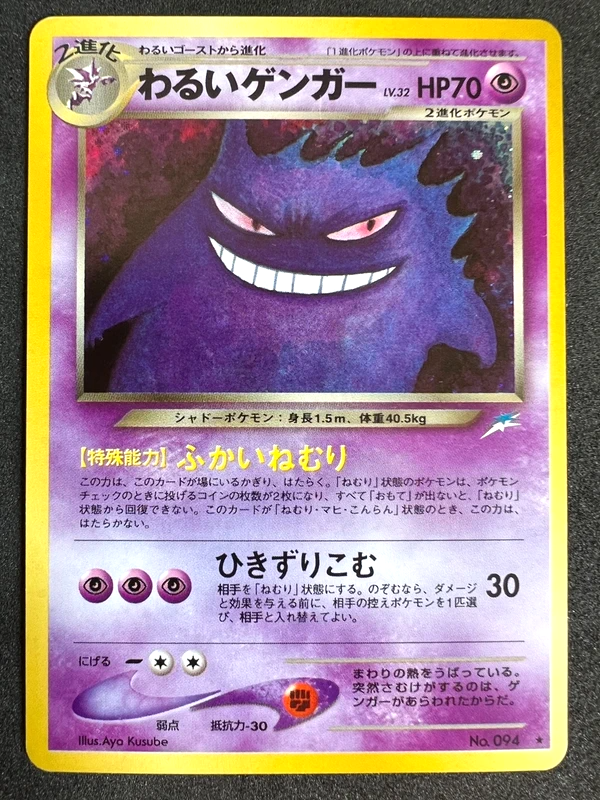
That card is わるいゲンガー — Dark Gengar, No.094, a holo from the 2001 Japanese Neo Destiny set "Darkness, and to Light…" (闇、そして光へ…). It is not the English Neo Genesis Gengar; it is a Dark-Pokémon-era Japanese print, and the Japanese holo carries a premium that the modern reprints never touch. Raw copies trade around $250, but graded, the same card tells a very different story — and that gap is the whole point of this piece.
Gengar is the rare Pokémon whose fandom is strong enough to lift a card in three different languages, four different eras, and every grade tier at once.The BuyTCG market desk
Why Gengar commands a premium
Popularity is not a soft factor in trading cards — it is the demand curve. Gengar sits in the small club of Pokémon (with Charizard, Pikachu, Mew and Umbreon) whose merchandise, competitive play and nostalgia keep a permanent bid under every printing. The 1st Edition Fossil Gengar #5 is the crown jewel: raw copies sit near $240, yet PSA 10s guide around $8,700 and exceptional sales have cleared far higher. That single spread — a ~35× jump from raw to gem — is the market telling you exactly how much collectors will pay for a flawless Gengar.
The Dark-Pokémon era adds a second layer. In the Neo Destiny set, "Dark" Pokémon were villain-flavoured, corrupted versions with sinister art — and Gengar, already a ghost, was the perfect canvas. The Japanese Neo Destiny holo is scarcer and older than the English reprints most people know, and Japanese vintage carries a structural premium: smaller original print runs, fewer preserved copies, and a global collector base that increasingly prizes the original-language card. That is why a raw Dark Gengar sits near $250 while an English modern Gengar of similar age can be had for pocket change.
The grading-upside story
Here is the arithmetic that makes collectors pay attention. A raw Dark Gengar costs about $250. Send it to PSA and a 9 is worth roughly $1,040 — already a 4× on the card alone. A PSA 10 is worth about $4,250, a 17× on your raw basis. The entire value of this card lives in the last half-point of surface, and that is exactly where a vintage Japanese holo is hardest to nail: the dark holofoil field shows every print line and micro-scratch under angled light.
That asymmetry is the play — and its trap. Grading fees and insured shipping add roughly $30–$100, a PSA 9 outcome still roughly quadruples your money, but a 9 is not a 10, and the four-figure premium only lands if the card gems. Run your own probabilities below: the break-even number the calculator returns is the confidence your eyes have to beat when you inspect that holo in hand.
What decides a 9 versus a 10
Neo Destiny holos live and die on surface. The dark holofoil field behind Dark Gengar reveals every print line, factory wax smear and hairline under angled light — the single most common reason a vintage Japanese holo lands at 9 instead of 10. Centering matters too: the Japanese Neo-era frame is unforgiving, and a hair off-centre caps the grade before the surface even gets a vote. Before you dream of the $4,250 print, zoom in on the card you actually hold.
The two Gengars in this story
The verdict
Gengar's popularity is not a story that ends — it is the demand that keeps five-figure Fossil holos and modern alt-art trophies bid up, and it quietly holds a floor under the older Japanese cards nobody talks about. The Neo Destiny Dark Gengar is one of those: raw at ~$250 with a gem outcome near $4,250, it is one of the cleaner grading-upside plays in vintage Japanese Pokémon — as long as the surface earns it. Buy the card, not the fantasy grade; then let the collectors who never stopped loving Gengar do the rest.
Frequently asked questions
Is this the same as the English Neo Genesis Gengar?
No. This is わるいゲンガー — Dark Gengar No.094 — a holo from the 2001 Japanese Neo Destiny set 'Darkness, and to Light…' (闇、そして光へ…). It is a Dark-Pokémon-era Japanese card, not the English Neo Genesis printing, and the Japanese holo carries a premium the reprints do not.
Why is a raw Dark Gengar worth around $250?
Two reasons: Gengar's enduring popularity keeps a permanent bid under every printing, and Japanese vintage carries a structural premium — smaller original print runs, fewer preserved copies, and a collector base that increasingly prizes the original-language card. Recent raw sales landed at $282, $270, $173 and $100, averaging near $250.
How much does grading add?
A lot. Raw is about $250, a PSA 9 is roughly $1,040 (last sold 29 Jun 2026, average $975), and a PSA 10 is about $4,250 (last sold 23 Jun 2026, average $4,400). A gem is roughly 17× the raw basis, which is why the last half-point of surface is the whole game.
Why do Gengar cards sell so well at auction?
Popularity is demand. Gengar has been a fan-favourite since the first generation, and that devotion shows across eras: 1st Edition Fossil Gengar PSA 10s guide around $8,700 with exceptional sales far higher, and the Fusion Strike alt-art Gengar VMAX (271/264) stays among the most-chased modern cards. When the trophies run hot, older Japanese Gengars get pulled along.
Sources
- PriceCharting — Dark Gengar, Japanese Darkness, and to Light… (Neo Destiny) raw & graded comps
- PokeData — Dark Gengar 094, Darkness, and to Light… graded values
- PSA Auction Prices — 2001 Japanese Neo 4 Dark Gengar holo #94
- PriceCharting — Fossil Gengar 1st Edition #5 (the trophy comp)
- TCGplayer — Gengar VMAX Alternate Art Secret 271/264, Fusion Strike