The Dark-Eeveelution Trade: Why a Japanese Neo Dark Espeon Runs Raw $189 to a $2,030 Gem
Espeon is the collector's Eeveelution, and the Japanese "Dark" Neo print is the one that commands the premium. Here's the market — and the grading-upside math that turns a $189 raw card into a $2,030 slab.
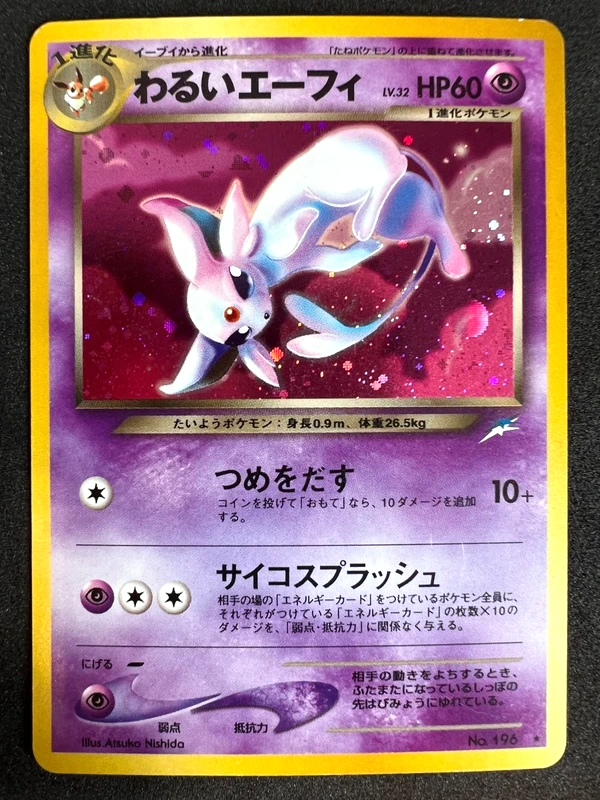
Two forces converge on one card. The first is Espeon — arguably the most beloved of the eight Eeveelutions, a Psychic-type that collectors chase across every era of the hobby. The second is the Japanese "Dark Pokémon" archetype from Neo Destiny — 悪, the shadow line whose art and lore made these among the most characterful holos of the vintage run. Where they meet is わるいエーフィ (Dark Espeon), No.196, from the 2001 Japanese set 闇、そして光へ… ("Darkness, and to Light…"). A raw copy trades near $189; the same card in a PSA 10 slab clears around $2,030. That gap is the whole story.
In the Eeveelution hierarchy, Espeon and Umbreon sit at the top of collector demand — and the Japanese "Dark" Neo prints are where the vintage premium lives.The market's read on the Neo Destiny dark-eeveelution line
Why Espeon anchors the Eeveelution market
Eeveelutions are the hobby's most durable character franchise, and demand inside that group is not evenly spread. Espeon and Umbreon — the Johto-era pair introduced alongside Neo — consistently pull the deepest collector interest, and that demand compounds on vintage prints where supply is genuinely thin. The Neo Destiny "Dark" versions add a second layer: the 悪 (Dark) archetype reimagined each Pokémon with edgier art and a distinct holo pattern, turning わるいエーフィ into a card that trades on aesthetics as much as scarcity. Espeon's newer chase cards can reach into four figures at gem level, but the vintage Japanese Dark holo is the one with pedigree — a 2001 print that predates the modern Eeveelution boom by two decades.
Why the Japanese "Dark" Neo print commands the premium
The English Neo Destiny Dark Espeon (#4/105) is a fine card, but the Japanese 闇、そして光へ… print is the one the vintage market treats as the reference. Japanese Neo sets were printed for a smaller domestic audience, the holo stock and centering read differently, and Japanese-first collectors prize the original-language copy — the same dynamic that lifts Japanese Base Set holos above their English twins. Layer that onto Espeon's franchise pull and the Dark archetype's cult following, and you get a card where the raw-to-gem spread is steep: roughly 10.7× from a $189 raw to a $2,030 PSA 10. That multiple is exactly where the grading-upside play lives — and exactly where it can go wrong.
The verdict
The Japanese Neo Dark Espeon is a rare case where the fundamentals and the math point the same way. Espeon is the Eeveelution collectors keep coming back to; the Japanese Dark print is the version with the vintage premium; and the raw price still sits low enough that the grading ladder — $189 raw, $502 at PSA 9, $2,030 at PSA 10 — pays off across almost every outcome except a surface-driven downgrade. The one thing a listing photo can't tell you is whether that dark holofoil is clean under angled light. Inspect that, and the rest of the case makes itself.
The card in this story
Frequently asked questions
Why is the Japanese Dark Espeon worth more than the English one?
The Japanese 闇、そして光へ… (Neo Destiny) print, No.196, is the reference copy for vintage collectors: smaller domestic print run, different holo stock, and strong Japanese-first demand. Layered on Espeon's Eeveelution popularity and the cult appeal of the Dark archetype, that pushes it above the English #4/105 at every grade.
How much does a Dark Espeon No.196 sell for by grade?
As of late June 2026: a raw near-mint copy trades around $189 (listings roughly $70–190), a PSA 9 clears near $502 with an average around $487, and a PSA 10 gem runs about $2,030, with a recent sale at $2,420.
Is grading a raw Dark Espeon worth it?
The math is favorable: at a ~$189 raw basis plus about $75 in fees, even a PSA 9 (≈$502) clears the cost and a PSA 10 (≈$2,030) is a large multiple. The risk is the dark holofoil surface — print lines and scratches that drop a 10 to a 9 — so in-hand inspection under angled light matters before you submit.
What makes Espeon so popular among Eeveelutions?
Espeon and Umbreon, the Johto-era pair introduced with the Neo era, consistently draw the deepest collector demand of the eight Eeveelutions. That franchise pull compounds on scarce vintage prints, which is why a 2001 Japanese Dark Espeon holo commands the premium it does.