A CGC 10 Spanish Raichu Sold for $5,200 Against a $15,000 Ask — The Crack & Regrade Math
Six months at $15,000, then one accepted offer at $5,200. Why the gap exists, what a PSA crossover could be worth, and the honest math of cracking a gem.
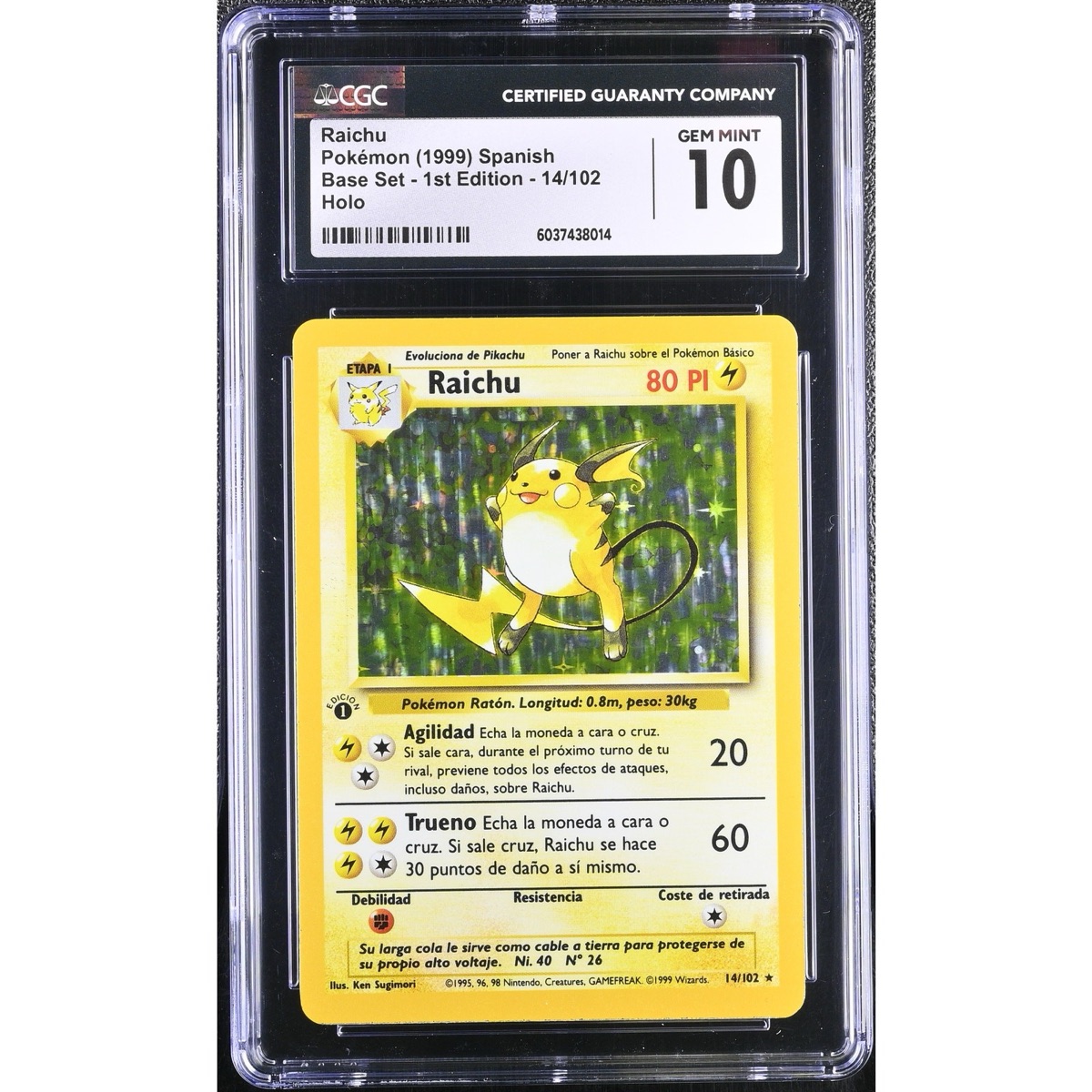
On 14 March 2026, a CGC 10 GEM MINT Spanish 1st Edition Raichu — Base Set 14/102, holo, cert 6037438014 — closed on eBay via Best Offer at $5,200. The asking price was $15,000, and archived snapshots show it had been sitting there since at least September 2025. That is a 65% haircut on one of the scarcest gem-graded versions of a card every Base Set collector knows.
CGC 10 GEM MINT Raichu 1st Edition 14/102 Spanish Base Set (PSA/BGS) Pop 2The eBay listing title, verbatim
Why a gem sells at a 65% discount
The gap is not about the card. It is about the label. In vintage Pokémon, PSA slabs command a structural premium: deeper bidder pools, cleaner comps, registry culture. CGC — a titan in comics that entered cards in 2020 — grades to standards many collectors consider equally strict on surface, yet its vintage gems routinely clear at a fraction of PSA money. The same asymmetry powers an entire cottage industry: buy the undervalued holder, free the card, resubmit it.
Scarcity is the other half of the story. Spanish Base Set was printed by Wizards of the Coast in 1999–2000 for a far smaller market than the English run, and almost nobody was sleeving Spanish cards for posterity. The listing title claimed a combined PSA/BGS population of just two at the gem level, and while seller pop claims always deserve a skeptical read, graded Spanish 1st Edition holos are genuinely thin — for comparison, the English 1st Edition Raichu counts 89 PSA 10s out of roughly 2,786 graded.
The crack & regrade thesis
The play is simple to describe and brutal to execute: crack the CGC slab, submit the raw card to PSA, and pray the surface reads 10 twice. If it does, a $5,200 purchase becomes a five-figure card — English 1st Edition Raichu PSA 10s guide around $9,730, and a Spanish gem with a near-zero pop could plausibly beat that at auction. If it does not, you now own a PSA 9 Spanish Raichu worth roughly what a nice dinner party costs, and the CGC 10 label you paid for no longer exists.
That asymmetry is the whole game. Grading fees and insured shipping add several hundred dollars, a PSA 9 outcome incinerates most of the position, and there is no undo. Run your own probabilities below — the break-even confidence the calculator spits out is the number your eyes have to beat when you inspect that holofoil.
"If the surface can be cleaned" — what that actually means
Base Set holos live and die on surface. The dark holofoil field shows every print line, factory wax smear, and micro-scratch under angled light — it is the single most common reason a vintage holo lands at 9 instead of 10. Some of that is permanent damage; some of it is loose factory residue that a dry microfiber cloth removes without touching the card's structure. Knowing which one you are looking at is the entire skill.
Be precise about the line: gently lifting surface residue is accepted practice; anything beyond it — solvents, erasers, polishing, trimming, recoloring — is card alteration. PSA rejects altered cards, the grading community treats it as fraud, and an altered vintage card is functionally worthless. The thesis here is narrow: if what kept buyers cautious is removable haze rather than embedded scratches, the card may present cleaner raw than it does behind CGC plastic. That is a big if, and it is exactly what the zoom below is for.

The verdict
At default assumptions the crossover is a coin-flip dressed up as a trade: you need roughly 45% confidence in a PSA 10 before the math turns positive, and that confidence has to come from in-hand inspection under angled light, not from a listing photo. The quieter take is that the buyer may not need to crack anything — $5,200 for a top-pop Spanish 1st Edition Raichu gem is the kind of entry that looks smart on its own in five years. The $15,000 ask was a fantasy; the $5,200 print is now the comp.
Frequently asked questions
What does "crack and regrade" mean?
Breaking a card out of its current grading slab and resubmitting it raw to another grader (usually PSA) hoping for an equal or better grade — and the price premium that comes with the new label. The original grade is destroyed in the process, so a worse result cannot be undone.
Is it OK to clean a card before grading?
Only in the narrowest sense: gently lifting loose surface residue or factory wax with a dry microfiber cloth is generally accepted. Solvents, erasers, polishing, trimming, or any physical or chemical alteration is card doctoring — graders reject it, and an altered card loses essentially all collector value.
Why do CGC 10 vintage cards sell below PSA 10s?
Market structure, not card quality. PSA has the deepest vintage bidder pool, the longest comp history, and registry demand, so its label carries a liquidity premium. That gap is exactly what makes undervalued CGC gems a crossover target — and why the play stops working if the gap ever closes.
How rare is the Spanish 1st Edition Base Set Raichu?
Spanish Base Set was a much smaller 1999–2000 print run than English, and very few copies were preserved mint. Graded gems are scarce enough that this listing claimed a combined PSA/BGS pop of two; the English 1st Edition Raichu, by contrast, has 89 PSA 10s out of about 2,786 graded.